

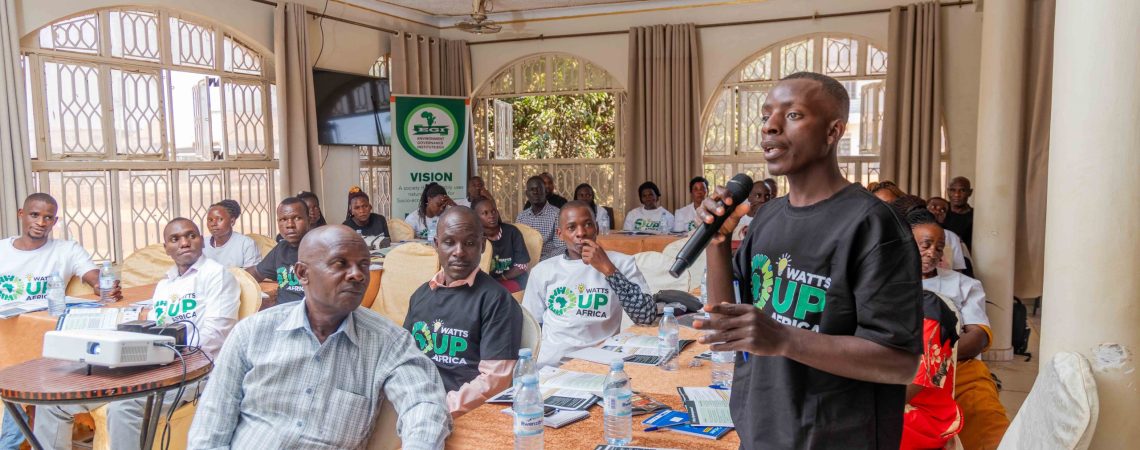
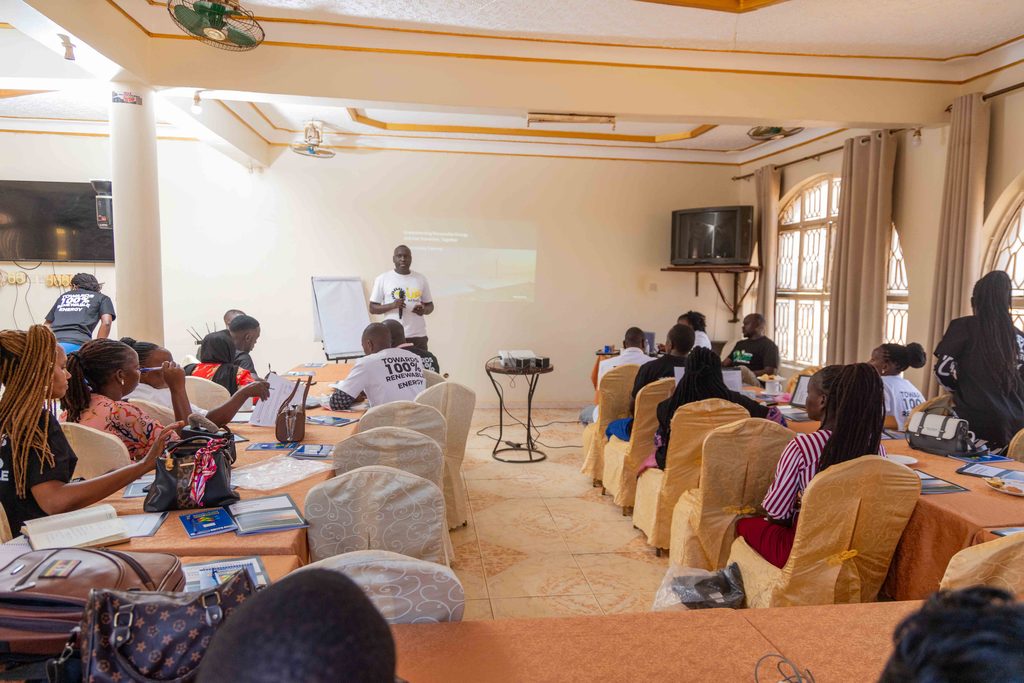
John Peter Okwi , Programs Coordinator , EGI presenting during the training
In March 2026, Environment Governance Institute conducted 20 in-depth interviews, equally representing women and men, alongside interviews with local and opinion leaders and direct observation of household energy practices.
The research, conducted in the EACOP-affected areas of Kakuuto in Kyotera and Lwanda in Rakai, sought to understand how communities use, consume and produce energy, their views on renewable and fossil-fuel energy, their willingness to embrace cleaner alternatives and the energy needs that should inform a Just Energy Transition. EGI conducted 20 in-depth interviews, equally representing women and men, alongside interviews with local and opinion leaders and direct observation of household energy practices.
The findings enabled EGI to organise the next engagement with communities, an effort to take the research findings back to the people, deepen understanding of renewable energy and the just energy transition, and document what communities were already doing with the energy solutions available to them.
That process culminated in a two-day community training and field visit conducted on 9–10 September 2026 in Kyotera and Rakai, in partnership with Power Shift Africa through its Watts Up Africa campaign.
The subsequent field visit also returned to the question of access. The team found several solar-powered homes along the electricity grid pathway that were still not connected to the national grid. This prompted a recommendation to investigate the reasons for this gap and share the findings with relevant utility and district stakeholders.
Solar panels were observed on rooftops and in open spaces, and solar was often the primary or only accessible renewable energy solution for households. At the same time, awareness and exposure to other renewable technologies remained limited. Biodigester technology, for example, was observed in only two households.
But the research also uncovered a challenge beyond access: perception and knowledge. Some respondents questioned the quality of solar lighting, believing that it could be dim, affect eyesight or damage mobile phones. Others held beliefs about solar energy having unusual effects, including influencing rainfall patterns. The research also found limited local technical support for the installation, repair and maintenance of renewable-energy systems, forcing communities to rely on service providers located far from their villages.
These findings helped inform the decision to move from research to community learning and sensitization. During the September training, community members were taken through the differences between renewable and non-renewable energy, how solar, wind, hydropower, geothermal and biomass work, and the advantages and challenges associated with different energy sources. The training also explored the difference between renewable and clean energy and introduced participants to the concept of a just energy transition.
The approach was deliberately practical. Participants did not simply listen to presentations; they worked with a training booklet, participated in exercises and discussed scenarios that connected energy choices to everyday life.
In Kakuuto, the team documented the story of Ssali Jude, whose bar and lodge business relies on reliable lighting and electricity. Solar provided him with an alternative source of power and helped him maintain business operations.
The team also met Agnes Namusiitwa, who had incorporated a solar-powered fruit dryer into her wine-making activities. Solar was helping her process locally available agricultural produce and turn it into an income-generating product.
In Lwanda, Muliindwa Charles had invested in a solar-powered water pump to protect his coffee plantation during an extended dry period. The pump allowed him to provide water to his coffee trees when rainfall was insufficient.
This evidence has informed recommendations to identify additional renewable-energy solutions that can support households, schools, farms and small businesses, while exploring concrete and affordable entry points for solar adoption.
In Lwanda, the team met Nambabali Sulaina and other community members involved in fish farming. Their fish pond had become an income-generating activity, with their most recent harvest generating up to UGX 1.2 million.
However, the oil pipeline route passed only a few meters from the pond. Following the burial of the pipeline, the community group had to relocate the pond to another location.
The experience provided a practical example of an issue that cannot be captured fully through statistics alone.
During the training, participants discussed how communities and leaders could work together to develop better energy solutions. Their proposals included mobilizing communities around shared energy goals, sensitizing people about energy options, identifying reliable and affordable energy sources, establishing energy management committees and learning from other communities with successful energy solutions.


