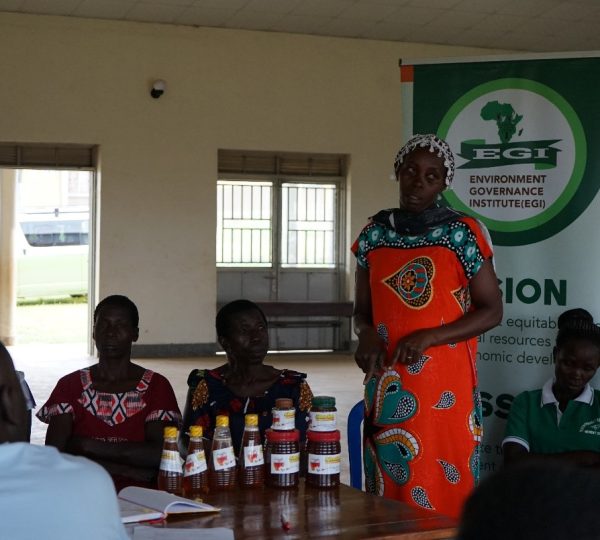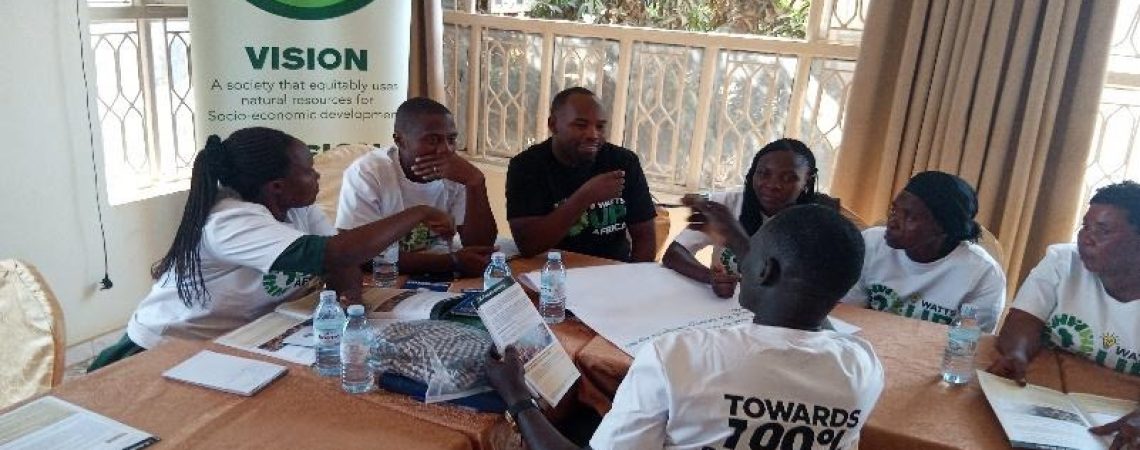
On 9 September 2026, the Environment Governance Institute (EGI) Uganda, in collaboration with Power Shift Africa through the Watts Up Africa renewable energy campaign, rolled out a renewable energy awareness training in the two greater Masaka districts of Kyotera and Rakai.
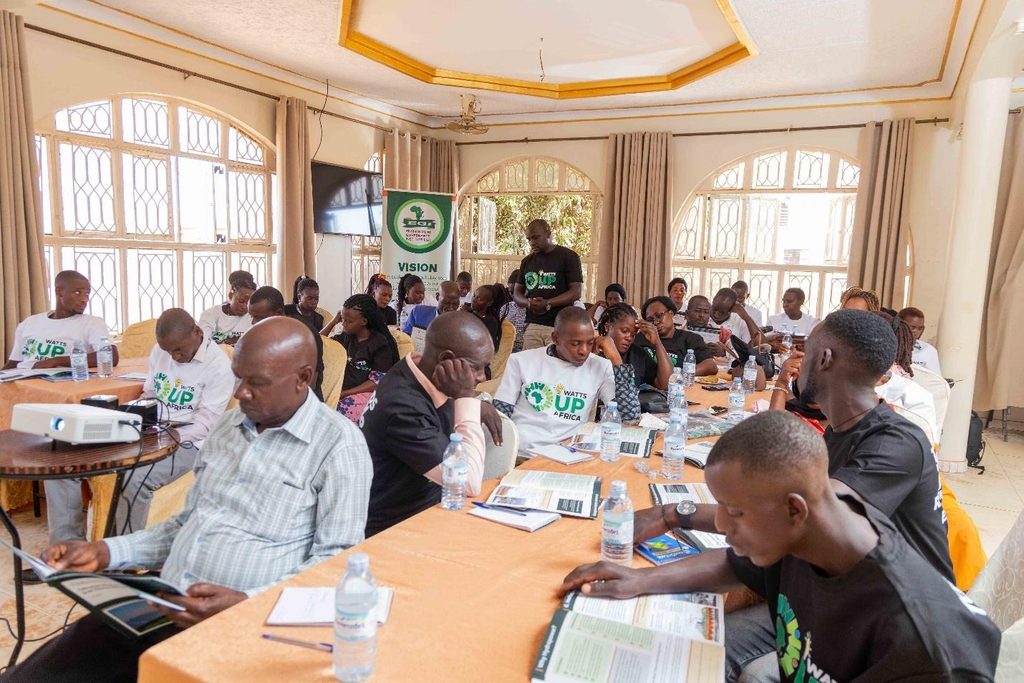
Participants going through the Luganda translated manual on renewable energy, during training in Kyotera
The training impacted over 35 youth, women, religious leaders and elderly community members drawn from the oil-affected villages of Lwanda, Kamuli, Kakuuto and Mayanja, purposely selected from the aforementioned districts. The training was aided through a translated Watts up Africa renewable energy manual, ultimately enabling knowledge transfer models and opening spaces for communities to tap into various renewable energy technologies, understand the vicious cycles affecting public accountability, and shape community conversations for a just energy transition.
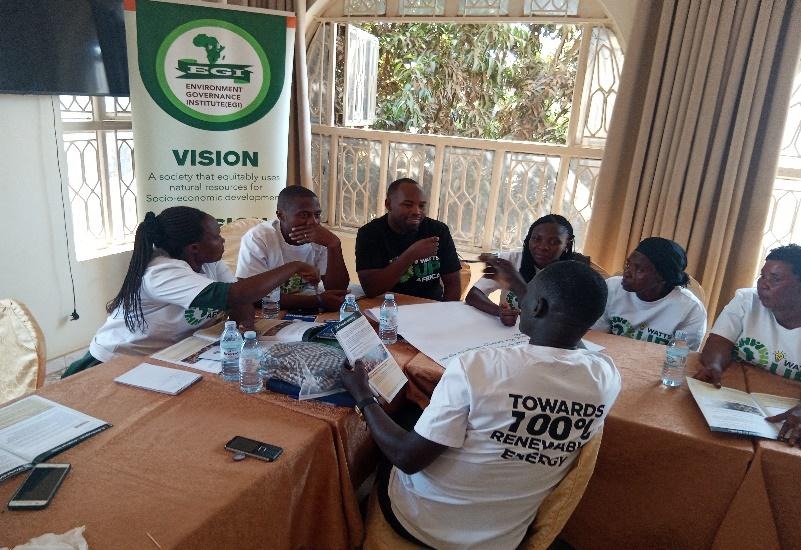
Communities members designing strategies to ensure public accountability on energy developments
Ms. Kapwani, a representative from Power Shift Africa, noted in her opening remarks that in many households, energy discussions often focus only on electricity, without considering the broader role that renewable energy can play in improving livelihoods, supporting businesses, reducing household energy costs, improving health, protecting the environment and strengthening community resilience. At the same time, many communities are expected to participate in decisions about new energy projects despite having limited access to information about renewable energy technologies and the concept of a just energy transition.
Samuel Okulony, EGI’s Chief Executive Officer, noted that the Watts Up Africa renewable energy awareness initiative is timely. It builds on a recent renewable energy perspectives study undertaken by EGI, which highlighted that while solar energy is the most dominant and widely used renewable energy source within the communities, community capacity to maintain systems was low. This was coupled with misconceptions about solar energy use and limited knowledge and exposure to other renewable technologies remained limited.
The training complemented and fed into the wider Mission 300 World Bank initiative to scale up and connect 300 million people in Sub-Saharan Africa’s last-mile communities to clean electricity. Local communities were given spaces to share their perspectives on a just energy transition, take ownership of renewable energy technologies within their reach, and scale up knowledge-transfer models through translated Watts Up Africa renewable energy community booklets.
Mulira Charles, one of the religious leaders from Kamuli village, Rakai district, noted: “The good thing about the training manuals is that they are available in multiple languages—some in English and others in Luganda. As a catechist, I can dedicate 20 minutes to teaching the congregation about generating energy from using available community technologies and resources.”
During the renewable energy awareness training, John Peter Okwi, EGI’s Programmes Coordinator, noted:
“The partnership between EGI and Power Shift Africa is about scaling up that awareness, so that more communities can understand renewable energy, clean cooking, climate change and the just transition and can demand accountability in energy planning. The goal is to build a network of informed community members who can carry this knowledge back into their own households and villages.”
Community members freely shared experiences and stories of energy transition within their families.
“When grid electricity came to our community in Kakuuto, I was one of the first residents to connect my household and business to it,” asserted Mr. Salli, a former Local Council III chairman of Kakuuto Sub-county. However, repeated outages forced him to look elsewhere. He invested in a 200-watt solar system with robust battery storage, now powering lighting, television and partial refrigeration at his lodge. It has cut his generator fuel costs and ended the kerosene fumes, locally known as “Tadoba”—that had affected his household’s health. For small businesses, his story suggests, solar is not a luxury. It is an investment in continuity.
Namusitwa Agnes, one of the key women leaders, embraced the initiative: “With this knowledge, I am going to scale up my solar fruit technology to expedite my wine-making process using fruits. I have just been using a 100-watt power panel, but now I want to scale it up to a 250-watt power panel to strengthen the effectiveness of solar power to serve home energy needs for drying and processing my wine, coupled with lighting for storage.”
Through this intervention, EGI and Power Shift Africa envisage mapping out and creating 10 renewable energy model houses within the sub-counties of Kakuuto and Lwanda in Kyotera and Rakai districts, respectively. These will bolster knowledge sharing and community-led exchange visits to leverage sustainable, inclusive and community-led just energy conservation.
Blog story By John Peter Okwi, Programmes Coordinator, EGI-Uganda