

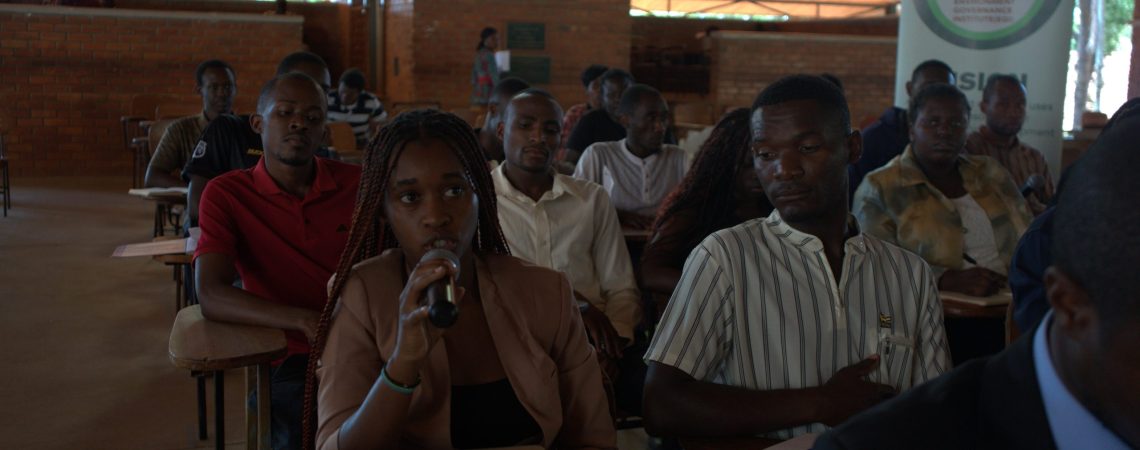
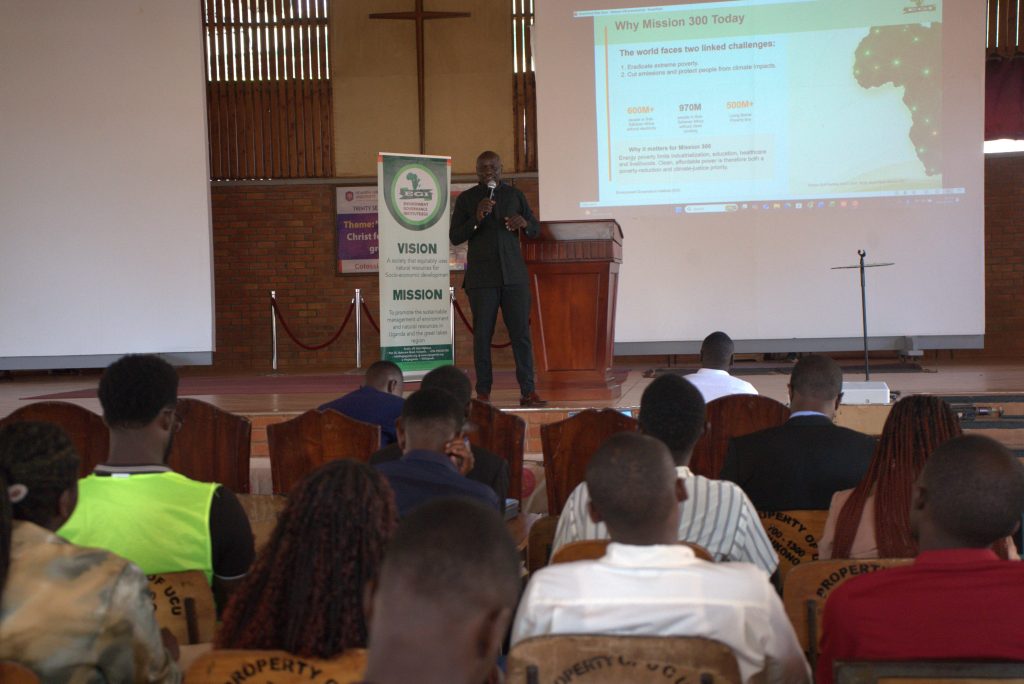
On 6 July 2026, the Environment Governance Institute (EGI), in partnership with the Uganda Christian University (UCU) Students’ Council, conducted a public lecture aimed at raising awareness of Mission 300 among youth and students. The event drew over 50 participants, including academia, youth leaders, student council representatives, and students from diverse disciplines of Engineering, Environment, Social Sciences, Economics, and Law.
The public lecture came at a pivotal moment when the Government of Uganda, alongside 34 other sub-Saharan African countries, are preparing grounds to implement and track their National Mission 300 Energy Compact. The energy compact agreements, an endeavour that will jumpstart the journey to accelerate efforts to expand energy access and increase last-mile electricity connections.
This public awareness lecture formed part of EGI’s wider African campaign to promote Mission 300, an ambitious initiative led by the World Bank and the African Development Bank to connect 300 million people across Africa to electricity by 2030.
In his keynote address, Samuel Okulony, Chief Executive Officer of EGI, framed Mission 300 as a response to two major global challenges. The first is energy poverty, with over 600 million people across Africa still lacking access to electricity and clean energy. This continues to limit economic growth, education, healthcare, and overall development. The second challenge is climate change, which continues to affect livelihoods, agriculture, and vulnerable communities, particularly in the Global South.
He further challenged students to see themselves not as passive beneficiaries of Uganda’s energy transition, but as innovators, researchers, and future leaders capable of driving sustainable change.
The public lecture was anchored in a central question that brought together students, university leaders, and energy governance experts: What role can young people play in transforming Uganda’s energy future?
This question sparked rich discussions and reflections throughout the session, with speakers and students alike contributing diverse perspectives on how youth can actively shape the country’s energy landscape.
John Peter Okwi, EGI Programmes Coordinator , underscored the need for students to tap into the opportunities presented by Mission 300. He noted that Uganda’s National Energy Compact recognises young people as key drivers of expanded energy access. He added that the initiative is expected to support youth empowerment programmes, skills development, and innovation.
He further highlighted the government’s plans to launch a Youth Green Corps programme, which he believes could equip young people and students across the country with practical skills in renewable energy, solar installation, grid maintenance, and digital energy systems. This, he argued, would position young people at the forefront of Uganda’s energy transition.
Student voices brought the discussions to life with grounded, community-centred insights. Charles Tumusiime, an engineering student, captured a critical challenge facing rural communities. He asserted that Mission 300 presents an important opportunity, but the government must also support and train communities to correctly size solar systems for household and productive uses.
He noted that most communities do not know the appropriate solar system capacities required to support productive activities such as refrigeration, ironing, cooling, irrigation, and the charging of multiple mobile phones. This knowledge gap, he emphasised, limits the effective and efficient use of solar technologies for productive purposes in Uganda, highlighting the need for targeted training and community engagement.
The UCU Guild President, Abraham Elobamoni, encouraged students to transform academic research into practical solutions that benefit society. He emphasized that universities should nurture ideas that extend beyond classrooms and laboratories and reach communities where they can create meaningful impacts on energy access and climate change mitigation.
His remarks resonated with many students who see their academic work as a platform for real-world change rather than merely a theoretical exercise.
The engagement culminated in an interactive session during which students, led by Mr. Mwanje Tom, Head of the Department of Engineering, initiated plans to organise inter-university symposiums. These platforms will enable youth and students to showcase clean energy innovations, demonstrate research relevant to Mission 300, and develop promising ideas into scalable solutions that contribute to Uganda’s national energy objectives.
The symposiums are envisioned as regular gatherings that will sustain momentum and create a pathway through which student innovations can contribute to national energy access and development priorities.
Throughout the lecture, students were encouraged to develop practical innovations, engage in interdisciplinary research, work closely with communities, and collaborate with government and private-sector actors to transform ideas into real-world solutions.
Universities were also challenged to create more platforms where student innovations can be showcased and connected to policy and investment opportunities. Among the key recommendations were the establishment of innovation hubs and research fellowships, as well as the organisation of regular clean energy symposiums to sustain youth engagement beyond the lecture.
In response to these recommendations, students pledged to create university energy hubs and collaborate with the government to access national seed-grant opportunities for Mission 300-related innovations. They expressed optimism about the opportunities ahead and committed to translating their academic knowledge into tangible solutions that address Uganda’s energy challenges at the grassroots level.
As part of its broader Mission 300 campaign, EGI pledged to expand these initiatives into regional online clean energy symposiums, through which young people across East Africa can coordinate their efforts, share success stories, and strengthen youth networks supporting the expansion of clean energy.
This regional approach, the Institute believes, will foster cross-border learning and amplify the impact of youth-led innovations across the continent.
As Uganda’s and Africa’s energy transitions unfold, EGI remains committed to creating spaces where students and young professionals can engage with national development priorities, strengthen their capacities, and become champions of an inclusive and just energy transition.
EGI therefore calls upon governments across sub-Saharan Africa, the World Bank, and the African Development Bank to strengthen regional youth engagement under Mission 300 and increase support for last-mile youth innovations that advance the productive use of energy.
The future of Africa’s energy sector, EGI argues, lies in the hands of its young people—and the time to invest in them is now.
Blog article by:
Elizabeth KulumeProgramme Assistant
EGI Uganda


